
PROYECTOS de la EOAA-2026
Del 2 al 6 de noviembre de 2026
Asesora: Dra. Ana Luisa González-Morán (INAOE)
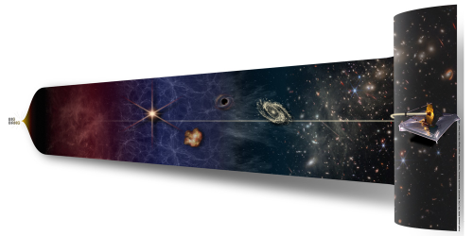
Resumen: An independent determination of cosmological parameters is important to assess the need for possible new physics beyond the standard cosmological model and to better control systematic uncertainties, given tensions in current cosmological parameter measurements. This project focuses on providing observations of HII galaxies using a single distance estimator over a vast redshift range (0 < z < 13). HII galaxies are young outbreaks of star formation with a spectrum that shows intense emission lines. Thanks to them and the use of the JWST, we can observe the first-formed galaxies in our Universe that play a fundamental role in the formation of massive galaxies, as well as measure cosmological parameters with high precision. So, this course will give an overview of these first discoveries and the cosmological results found. It will also highlight a new program aimed at finding and studying the physical properties of new HII galaxies with the JWST.
Asesora: Dr. Javier Álvarez-Márquez (CAB, España)
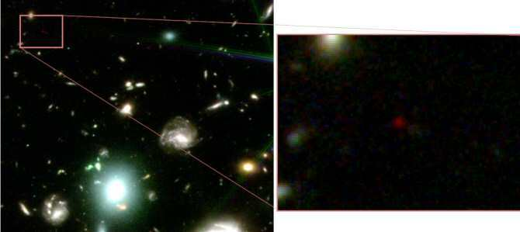
Resumen: This project will study galaxies with redshift above 10 using public available MIRI low resolution spectroscopy. The student will fully calibrate the raw data with the JWST calibration pipeline, analyses the rest-frame optical spectrum, and derive the physical properties of the interestellar medium. Additional, if we have time, we will work with public available NIRCam and NIRSpec observations, covering the rest-frame UV spectrum, to perform spectral energy distribution fitting with CIGALE, and derive the stellar populations and star formation histories of that galaxies.
Más información:
Asesora: Dr. Divakara Mayya (INAOE)
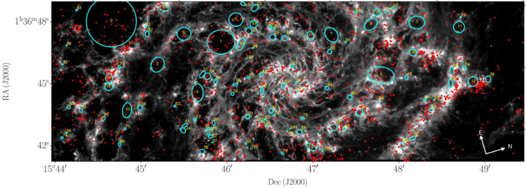
Resumen: Se usarán los catálogos de estrellas en las imágenes del JWST/NIRCam para generar CMDs. Posteriormente se identificarán distintas fases evolutivas en el diagrama, incluyendo la identificación del TRGB. El Proyecto consistirá en encontrar la edad de la población estelar en zonas seleccionadas, como por ejemplo en burbujas gigantes identificadas en las imágenes MIRI. También se aprenderá a obtener la distancia a las galaxias usando el método de TRGB.
Más información:
Asesora: Dra. Aida Nava de Wofford (IA-Ensenada, UNAM).
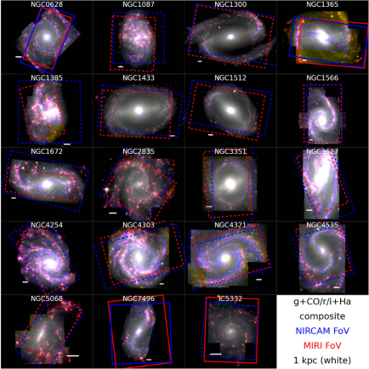
Resumen: En esta actividad aprenderás cómo se pueden estudiar las propiedades de cúmulos estelares, cuando debido a que se encuentran lejos, sólo se cuenta con la suma de la luz de sus estrellas (luz integrada) en diferentes bandas fotométricas anchas. Lo primero será obtener la fotometría. Intentaré cubrir los siguientes objetivos de aprendizaje (aunque quizás no dé el tiempo para ver el #7 en detalle):
Más información: